


Every flight out of Palma has at least a few of them, flat cardboard boxes tied with string, too wide to fit in an overhead locker properly, carried like they’re breakable. That’s ensaimada Mallorca in its most familiar form, the souvenir version, bought in a hurry at the airport on the way home.
It’s also, in a lot of cases, not quite the real thing. Consider this a proper Mallorca pastry guide to what’s actually in that box, because there’s more to this traditional Mallorcan pastry than sugar and a snail shaped coil, exactly the kind of detail Food Tours Balearics likes pointing people toward, not selling the pastry itself, just steering you to whoever’s still baking it properly.
What is ensaimada, actually
The basic recipe
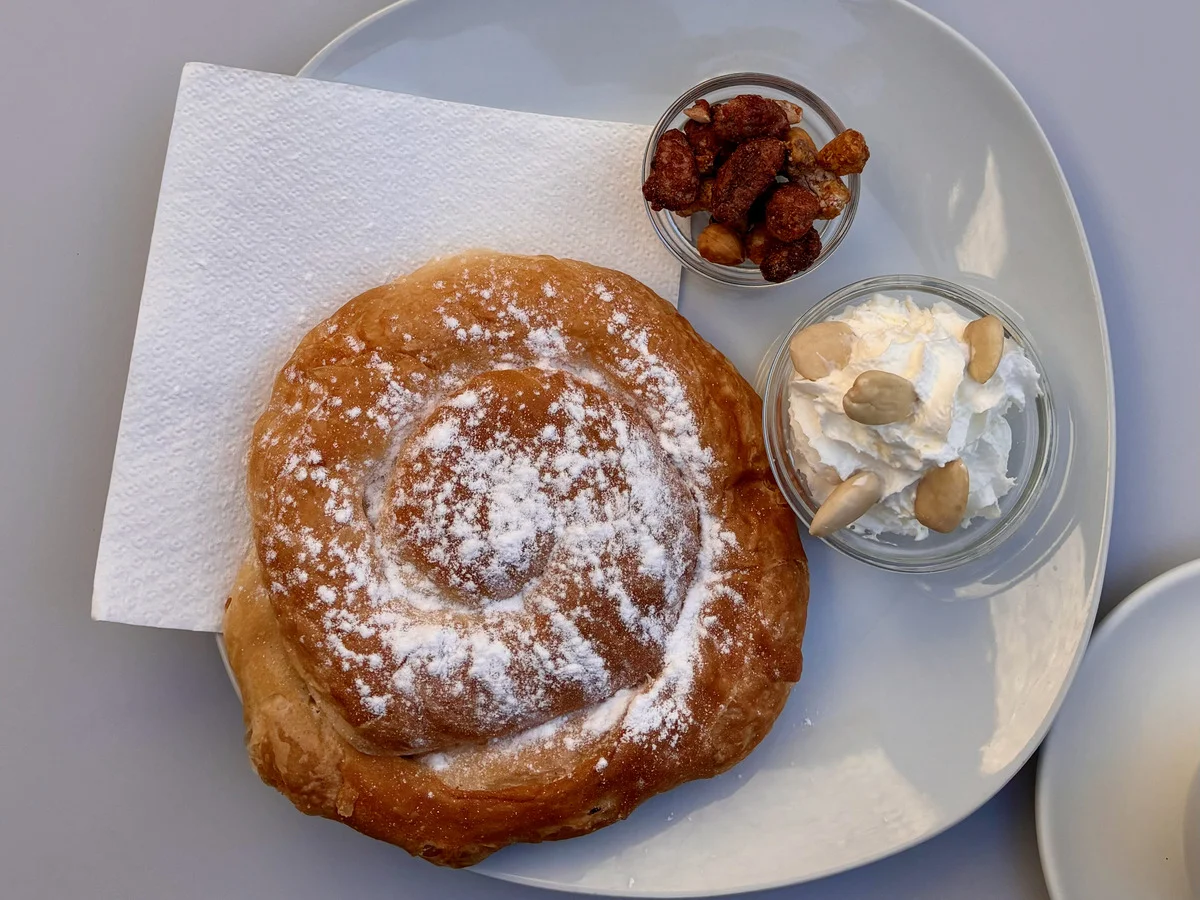
Strip it back to basics and ensaimada is a spiral of laminated dough, flour, water, sugar, eggs, a starter, and lard, rolled thin, coiled like a snail shell, left to ferment for half a day or more, then baked and dusted with sugar. That’s it. No cream, no chocolate, nothing hidden inside, just the dough and the process.
If you’ve only ever asked what is ensaimada in passing, that’s the short answer. The longer one is that almost every step is written into an actual regulation, not just tradition, which is unusual for something this humble looking.
Why lard, specifically
The name itself is the giveaway. It comes from saïm, the old Mallorcan word for lard, and that’s not a small detail. Lard isn’t a flavour choice here, it’s structural, it’s what makes the dough laminate into those thin, flaky layers rather than baking up dense. Swap it for vegetable fat, which plenty of mass producers do because it’s cheaper and keeps longer, and you get something that looks nearly identical in the box but isn’t really the same pastry anymore.
Why the coil shape matters too
The coil isn’t decorative either. Rolling the dough into a long, thin rope and winding it into a spiral is what creates the pastry’s open, layered crumb once it bakes, similar in principle to how a croissant gets its flakiness, just achieved with a different fat and a longer ferment. Skip the lamination step and you’d just have sweet bread, not an ensaimada.
A history older than most people assume
Contested origins
Ensaimada history goes back further than the sugar dusted version most visitors know. Written references date to at least 1651, and the story behind it is genuinely contested rather than settled. Some food historians trace the coiled shape and use of animal fat back to Arab pastry traditions from before the 13th century reconquest. Others point to a specifically Mallorcan, or even Jewish, origin, with one theory suggesting lard was adopted precisely because it let conversos publicly demonstrate they’d abandoned kosher dietary rules.
Nobody has fully settled the debate, and that’s part of what makes it interesting. This isn’t a marketing story invented for tourists, it’s an actual, unresolved piece of ensaimada history that happens to be edible.
From aristocratic snack to island staple
By the 18th century it had become a fashionable snack among Mallorca’s middle and upper classes, usually served with hot chocolate. A century later it had spread well beyond the island, and it’s been baked more or less the same way ever since, which is a big part of why it still counts as a traditional Mallorcan pastry rather than a modern invention wearing an old name. It’s also exactly the kind of history that comes up naturally on a lot of the island’s self-guided food routes, somewhere between the bakery stop and the next glass of wine.
Why authentic ensaimada is more protected than people realise
Here’s the part most guidebooks skip. Ensaimada de Mallorca has held Protected Geographical Indication status since 2003, following an earlier Spanish designation from 1996, and the rules are stricter than you’d expect for a pastry mostly known as an airport souvenir.
What actually counts as protected
Under that protection, only two versions actually qualify as legally certified: the plain ensaimada, called llisa, and the one filled with cabell d’àngel, a candied pumpkin jam. Everything else you’ll see on a bakery counter, cream, chocolate, custard, even the savoury sobrasada version, is entirely real and often very good, it just isn’t covered by the same protected status. A shop claiming otherwise about its ensaimada de Mallorca is simply mistaken.
Why the rules matter
The rules also specify the flour, the fermentation process, and crucially, that it has to be made with lard rather than any substitute. That single ingredient requirement is really the whole point of authentic ensaimada, it’s not about nostalgia, it’s a legal definition of what’s allowed to carry the name Ensaimada de Mallorca in the first place.
Ensaimada fillings, and which ones are the real deal
If you’re working through the options on a bakery counter, here’s roughly what you’re choosing between when it comes to ensaimada fillings:
- Llisa (plain): no filling, just the dough itself, one of only two IGP protected versions.
- Cabell d’àngel: filled with candied pumpkin jam, the other officially protected version, and arguably the most traditional filling there is.
- Crema or nata: filled with custard or whipped cream, common, delicious, but outside the protected designation.
- Chocolate: a modern favourite, again real and widely sold, but not part of the original recipe.
- Sobrasada: a savoury version filled with Mallorca’s cured, spreadable sausage, unusual to outsiders but a genuine local variation.
None of the non protected ensaimada fillings are lesser pastries exactly, they’re just a different thing wearing the same name.
Where to eat ensaimada like it’s meant to be eaten
Skip the airport version
The honest answer is that most tourists eat their first ensaimada backwards, cold, out of a box, hours after it was baked, on a plane. Locally, it’s usually breakfast, torn apart while still faintly warm, alongside a coffee rather than a suitcase.
Some of Palma’s bakeries have been making it the same way for centuries. Ca’n Joan de s’Aigo, tucked into the old town since 1700, is the obvious example, still working with the same lard, the same long ferment, and the same basic method it started with. Finding the best ensaimada in Palma really comes down to seeking out places like that, rather than the nearest shop to your hotel, and that’s really the difference between tasting authentic ensaimada and tasting a reasonable imitation of one.
What to actually look for
Age isn’t the only sign worth looking for either. A queue of locals rather than tourists, a case that isn’t stacked with pre-boxed pastries hours old, and a baker who’ll tell you plainly whether that batch used lard, are better indicators of where to eat ensaimada properly than anything printed on a sign.
If you’d rather have someone point you toward the right bakery instead of guessing, the Wine & Dine Tour through Palma’s Old Town threads past several of the old quarter’s best, alongside plenty of other things worth tasting on the way. The Santa Catalina route covers a different, trendier pocket of bakeries if you’re staying on that side of town instead.
The takeaway
An ensaimada Mallorca sold to a tourist and one made by a fifth generation baker using saïm and a two day ferment can look identical sitting in the same cardboard box. Only one of them is actually what the name describes, and only one is real ensaimada in the fullest sense of the word.
That’s not really a reason to feel cheated by the airport version, it’s just worth knowing the difference exists. Real ensaimada is a specific, protected, occasionally debated piece of Mallorcan history, not just a shape. Once you know what to look for, whichever of the ensaimada fillings you choose, it’s easier to find, and more satisfying to eat.
Consider this the short version of the Mallorca pastry guide you wished someone had handed you before your first trip. The best ensaimada in Palma is usually sitting quietly in a bakery that never bothered to put “traditional” in its window, because it never had to.